Why Originality Matters More Than Virality - Rahul Rajkhowa Interview
- Akash Jyoti Nath
- 11 Oct, 2026
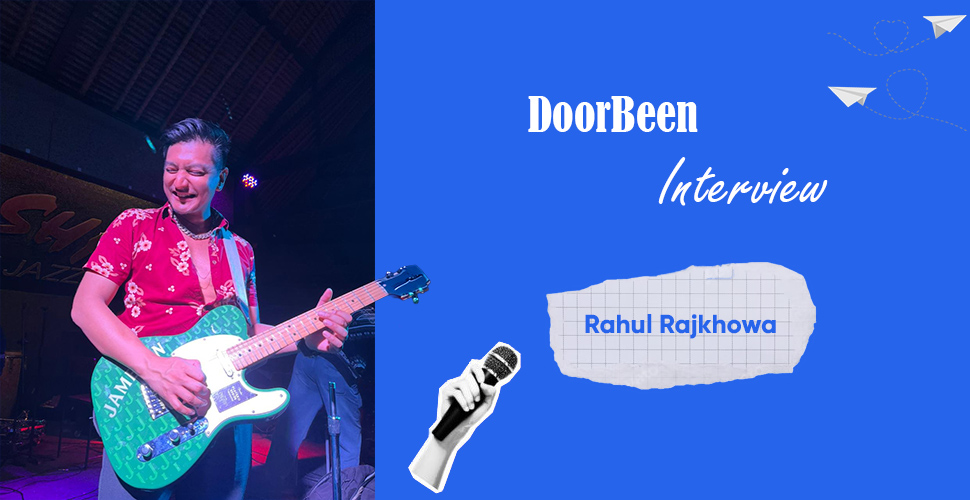
The northeast India music scene has always been rich with raw talent - but now, it’s louder, sharper, and closer than ever to breaking into the global mainstream.
In an exclusive conversation with DoorBeen, Assamese artist Rahul Rajkhowa spoke candidly about songwriting, social media, record labels, and why independent artists need to stop waiting for permission.
From working with Warner Music India to collaborating internationally, Rahul shared the blueprint for artists trying to build something real.
“My songs come from observation”
For Rahul, songwriting isn’t just creativity, it’s documentation.
“I’m a very observant artist,” he says.
From the Citizenship Amendment Bill protests to personal heartbreaks of friends, Rahul’s music often mirrors society and emotion. A history teacher by profession, he compares songwriting to journaling.
“I write about things that leave an impact on me. Usually, the music comes first, I compose the feeling, then I write the words.”
That emotional-first process has shaped his sound since 2017, when he started making socially conscious rap.
“No one is going to care for your music more than you”
Many artists struggle with self-promotion, but Rahul believes it’s an essential part of being an artist. From Reddit AMAs to short-form content, we’ve seen him explore different ways to get music in front of people. When asked what advice he would give emerging artists, his response was refreshingly blunt:
“You cannot sit and think someone else will promote your music for you. No one will.”
He points to artists like Hanumankind and Reble, who relentlessly pushed their music and built an audience before breaking through. For Rahul, promotion isn’t separate from the art; it’s part of the process.
“You spent months writing, recording, mixing, mastering, and then if you don’t promote it? That’s a loss.”
But beyond simply putting your music out there, Rahul emphasises the importance of building a distinct visual identity.
Build Your Aesthetic
“Your feed should look uniform. Today, music is also about visuals, colors, and branding.”
He cites artists like Chaar Diwaari and Reble as examples of musicians who have developed recognisable visual identities. In an increasingly crowded music landscape, having a consistent aesthetic helps artists stand out, build recognition, and create a world around their music.
The takeaway is simple: making great music is only half the job. Artists must also take ownership of how their music reaches the world.
“The Northeast is about to explode”
Rahul believes Northeast India’s indie scene is sitting on a goldmine of potential.
“We’re on the brink. It hasn’t happened fully yet, but it’s coming.”
He traces the roots of hip-hop in the region back to Mizoram’s Michael M. Sailo and legendary crews like Khasi Bloodz, while highlighting the current rise of artists like Reble and Rocky Glock.
His message to new artists?
Stay consistent.
The biggest challenge isn’t a lack of talent. It’s consistency. He has seen many artists start making music, only to gradually disappear from the scene.
“Artists give up because it takes too much time. During my time, a lot of artists were making music, but I don’t see them making music as much anymore.”
His message to emerging artists is simple: stay consistent, keep looking for inspiration and keep putting out music.
“You cannot celebrate your last hit forever. Move on. Release again.”
He also cautions artists against waiting for record labels to open doors for them.
“Labels today want artists who are already winning.”
In a scene full of potential, consistency could be what separates those who break through from those who fade away.
That’s why platforms like DoorBeen matter, giving artists the ability to release independently and build leverage.
How Warner Music India found Rahul Rajkhowa
One of the most revealing parts of the interview was Rahul explaining how Warner Music India approached him.
It wasn’t by chance.
Warner reached out after seeing his unique music and asked him to create “Toradoi”, a Bihu song with global appeal.
“They told us: make a Bihu song that sounds international.”
That became the blueprint. The main idea was to create a bihu Anthem that people in Bombay can also dance to.
The result? A folk anthem designed for both Assam and the world.
Rahul later toured the song across Mumbai, Kolkata, Delhi, and Bangalore, performing it to crowds of thousands.
\
Let the Labels Come to You
Rahul believes artists should focus on building their careers independently rather than chasing record labels too early. While he acknowledges that the journey isn’t easy, he feels that repeatedly approaching labels rarely works in an artist’s favour.
“It’s very difficult, and I wouldn’t say it is easy, but you should wait for the record labels to come to you rather than you trying to approach them.”
In his experience, nine out of ten times, approaching labels doesn’t lead to the desired outcome. Labels are more likely to take notice when an artist has already demonstrated their potential: consistently releasing music independently, building a listener base, and developing a sound that sets them apart.
And there’s another advantage to building that foundation first: better deals and greater negotiating power. When artists can demonstrate their value, they’re in a much stronger position to negotiate with labels rather than depending on them for their first breakthrough.
The story about Zubeen Garg
Rahul recalls a show in Tezpur back in 2017, where around 600–700 people had gathered. At one point, someone from the crowd shouted, asking him to sing a Zubeen Garg song.
Zubeen da had been a close family friend, but Rahul had never attempted to sing his songs. He knew he couldn’t recreate the magic of Zubeen da’s voice, and he didn’t want to try.
Instead, he responded with a simple analogy:
“Zubeen da is a Ferrari. I am a Maruti.”
The audience member loved the response so much that, after the show, he gave Rahul his ring.
That moment reinforced something Rahul had come to understand about being an artist: you don’t have to imitate someone else to earn people’s admiration. You need to discover what makes you different.
For Rahul, the lesson was clear: respect the legends, learn from them, but find your own voice. Because an artist’s real identity begins when they stop trying to be someone else.
Is language a barrier in global music?
Rahul’s answer: absolutely not.
He points to artists like Arijit Singh, who is the most followed artist on Spotify in theworld. And it’s Hindi music; Bad Bunny has the highestnumber of streams as an artist from around the world his music is Latin; AP Dhillon and Sidhu Moosewala is known for Punjabi music.
“People listen to K-pop without understanding Korean. Language isn’t the problem.”
For Rahul, quality is what matters.
“The music has to sound global, the mixing, mastering, production.”
“It’s not like language can never be a barrier. It’s just that you have to be so good at your craft, and the craft has to sound very good on streaming platforms. Then you have a chance of working globally.”
Sliding into DMs worked
Rahul also shared how he landed an international collaboration with Jimmy Brown for his EP Six Miles to Seoul.
His strategy?
“I directly DMed him.”
Simple.
His advice to artists looking for international features:
- Do your research
- Find artists you genuinely connect with
- Reach out directly
- Let your music speak
The hardest part of being independent
Rahul says rejection is the biggest reality.
“People won’t reply to your emails. That’s normal.”
He recalled trying to connect with artists early in his journey and getting ignored - something he now tries to change by mentoring younger artists.
His strongest takeaway:
“If you want an artist to collaborate with you, you have to ask yourself first that why will the artist want to collaborate with you?”
Rahul believes artists should have at least two solid EPs out before seriously pitching bigger names.
Final words: Success doesn’t come overnight
Rahul ended with a message every independent artist needs to hear:
“Success doesn’t come overnight. Stay consistent.”
And maybe that’s the entire truth of the modern music industry.
Not luck. Not labels. Not virality.
Consistency.
Watch the latest music video by Rahul Rajkhowa:
- #Rahul rajkhowa
- #Northeast indie music
- #Assam music industry
- #Independent artist interview
- #Indian indie music
- #Northeast hip hop
- #Assamese music
- #Music branding
- #Music promotion
- #Independent musicians
- #Record labels india
- #Warner music india
- #Indie artist advice
- #Music distribution
- #Doorbeen
- #Music marketing
- #Artist branding
- #Rahul rajkhowa interview
- #Northeast artists
- #Indian music scene
- #Global music from india
- #Assam indie scene
- #Music production
- #Independent music india
- #Music industry insights